The Need for Customer Focus: Why Not Every Prospect Should be Your Customer

The Growth Problem Most Teams Misdiagnose

Growth problems are often framed as execution failures. The campaigns were weak. The messaging missed. The pipeline was inconsistent. In many cases, the real issue sits higher up the strategy stack. Before tactics, before automation, before AI-generated content, there is a foundational decision to make: what is the right customer focus that your company is truly built to serve?

This is the discipline of customer focus. It is one of the most overlooked fundamentals in modern marketing, and it is one of the most powerful. As a fractional VP of Marketing, I often see teams trying to fix performance with more activity. More content. Run more ads. Do more outreach. Volume feels productive, but volume cannot compensate for a lack of focus. If you do not clearly define your Ideal Customer Profile, every downstream effort becomes diluted.

Continue reading The Need for Customer Focus: Why Not Every Prospect Should be Your Customer

Unlock Better Results with Clear Marketing Personas

What Is a Marketing Persona?

Marketing personas sit at the heart of an effective marketing strategy. If you have ever asked, what is a marketing persona, the simple answer is this: a marketing persona is a detailed profile of your ideal buyer. It describes who they are, what they care about, and how they make decisions. Strong marketing personas go beyond demographics and capture motivations, objections, and priorities.

From a Product Marketing Manager’s perspective, marketing personas are not optional. They are foundational tools for positioning, messaging, and product strategy. A PMM must understand the buyer deeply to shape features, benefits, and go-to-market plans. Without that understanding, marketing becomes guesswork dressed up as creativity.

Continue reading Unlock Better Results with Clear Marketing Personas

Marketing Disruption in the Age of Artificial Intelligence

Today, marketing disruption driven by artificial intelligence is no longer theoretical. It is visible in daily workflows, team structures, and performance expectations. Entire marketing functions that once required weeks of coordination now happen in hours. AI has compressed time, reduced friction, and redefined what effective marketing looks like.

Continue reading Marketing Disruption in the Age of Artificial Intelligence

How Do You Know What’s Being Said About Your Brand When You’re Not in the Room?

The importance of brand equity is one of the few constants in marketing. Everything else has changed. We’ve moved from print to websites, from static ads to dynamic digital campaigns, from SEO to social, and now to GEO. The channels and tactics continue to evolve at lightning speed. The way customers search, decide, and buy is completely different today than it was a decade ago. But one principle remains steady. People buy from a brand they recognize, trust, and feel aligned with.

That’s brand equity. And without it, no sale happens.

Brand equity is not just a logo, tagline, or color palette. It’s the sum of what people believe about you – your reputation, credibility, and emotional connection in their minds. It determines whether customers give you their attention, money, and advocacy.

Continue reading How Do You Know What’s Being Said About Your Brand When You’re Not in the Room?

Will AI Shatter the Old Walls Between Software and Hardware?

I’ve spent many years in high-tech leadership, having worked in several product marketing and analyst relations roles. I’ve overseen rebranding campaigns, new product launches, and messaging strategies, working with many teams focused on delivering products that bridge multiple architectures and deployment strategies. My experience has been primarily from a perspective of enterprise software. This includes understanding buyer personas, value propositions, and how to achieve the lowest total cost of ownership. More recently, I’ve begun working in the hardware and chip development industry, in the area of AI semiconductor design. Interestingly, I see more parallels today between the software and hardware industries – a convergence I attribute to the increasing influence of AI.

Now the direction is to orchestrate AI capabilities across hardware and software platforms. This shift is an “agentic” transformation. This wasn’t always the case. In September 2024, Salesforce was an early pioneer in taking a software approach to building agents. One of their Dreamforce 2024 tracks, Build Innovative ISV Apps with Agentforce, discussed how “ISV partners can build Agents and actions for Agentforce using Apex, flows, and prompt templates.”

I don’t recall any conversations about taking an agentic strategy to hardware back in 2024, but I might have missed it! My focus at that time was on closely monitoring the field service management vertical of the enterprise software stack.

Continue reading Will AI Shatter the Old Walls Between Software and Hardware?
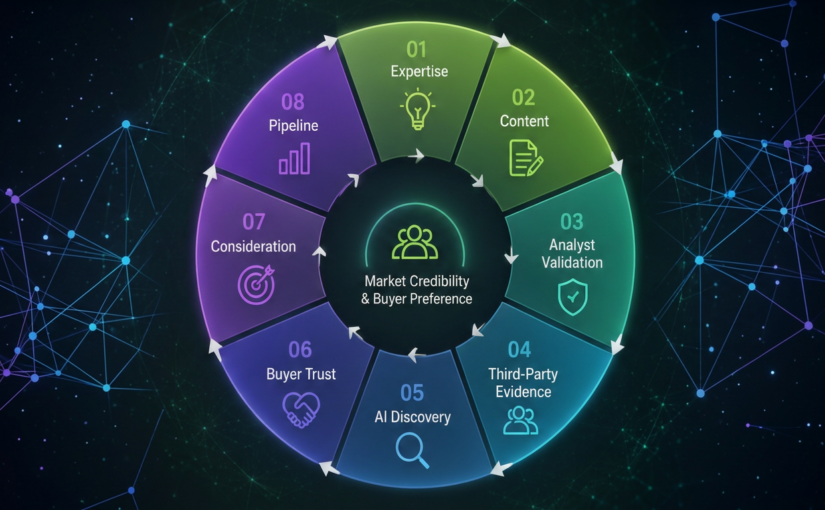
The New Role of Analyst Relations in the AI-Driven Buyer Journey

Marketing has transformed many times over the past two decades. The rise of websites reshaped commerce. SEO altered how companies attract buyers. Now, artificial intelligence is driving another major disruption – possibly the largest yet. The constant theme is clear: how to best invest resources to elevate brand awareness and customer engagement. The methods keep evolving, and the rules shift every few years.

At the Product Marketing Alliance Analyst Relations Summit on August 21, 2025, this shift was on full display. I attended the track titled “If GenAI can’t find you, neither can your buyers: The new role of AR in an AI-driven, buyer-led world.” The session was hosted by Rick Nash, CEO of Spotlight, and James Cadwallader, CEO of Profound. Together, they addressed how LLMs like ChatGPT, Gemini, Claude, DeepSeek, and Anthropic are incorporating industry analyst content and other third-party sources to shape AI-generated outputs. The message was clear: the role of analyst relations (AR) is entering a new era of importance within the AI-Driven Buyer Journey.

Those interested in watching the entire presentation can do so by registering to attend the Analyst Relations Summit. Once you have registered and created a profile, you should then be able to access the recordings.

Continue reading The New Role of Analyst Relations in the AI-Driven Buyer Journey

Building the Right Analyst Relations Program: Assessing Your AR Maturity

An analyst relations (AR) program can be a powerful business asset. It can influence market perception, shape product decisions, and help sales win deals. But one truth stands above all: an AR strategy is not “one size fits all.” Picking the right program depends on several factors. One is your organization’s level of AR maturity.

Those who are new to analyst relations might find interest in reading this article, Understanding Industry Analyst Relations: Definition, History, and Impact.

Every organization must build its AR program from its own perspective. That means aligning it to your unique goals, budget, and current maturity level. A strategy that works for a fast-growing startup might fail in a multinational enterprise. The challenge is understanding where you are now and what steps will deliver the greatest value next.

Continue reading Building the Right Analyst Relations Program: Assessing Your AR Maturity

Here’s Why You Need a Nurture Marketing Strategy

Marketers can sometimes think in narrow lanes, especially those working at larger enterprises. Success metrics are highly refined and focused such that it is easy to lose sight of the bigger picture. Growth marketers might just focus on new business, social media specialists target engagement and “likes,” while those responsible for customer marketing might just see events as their core KPI. Nurture marketing can sometimes fall through the cracks.

Unfortunately, this perspective can limit your organization’s overall marketing effectiveness. Instead, take a step back and picture your marketing universe as having three groups:

  1. Current customers
  2. Future potential customers
  3. People who will never buy from you

That third group is real. Don’t waste your time or budget trying to convert them. Instead, just focus on the first two and then apply this concept to all of your campaigns.

Continue reading Here’s Why You Need a Nurture Marketing Strategy

Win the Hidden Buyer Journey with Smart Influence

Attending the American Marketing Association (AMA) conference in June 2025 reminded me why I prioritize events like this. Each time, I aim to return with at least three new concepts I can apply or share. This year, one insight hit me hard—and it’s still on my mind. It focused on how, today, more than ever, a hidden buyer journey exists. Marketers need to take notice.

Up to 98% of a buyer’s journey happens before they ever visit a vendor’s website.

That’s not a typo.

This number flips traditional demand generation strategies on their head. It also presents a real challenge: how do you influence a buyer before they ever know you exist?

Continue reading Win the Hidden Buyer Journey with Smart Influence

The Right Metrics to Measure Analyst Relations Performance

In far too many enterprise software companies, analyst relations is treated like a box to check. It’s viewed as something that “just needs to be done.” Brief the analysts. Send the slide deck. Analyst relations performance is measured by showing up in a quadrant next year. Done, right?

Wrong.

This mentality is costing companies real momentum. When leadership sees analyst relations as a compliance function instead of a strategic lever, the program becomes misaligned with growth. It gets funded without being understood. It gets evaluated using shallow metrics. And worst of all, it misses the chance to position the company as a true force shaping the industry’s future.

The culprit? Bad assumptions—and worse KPIs.

Continue reading The Right Metrics to Measure Analyst Relations Performance