
Today, marketing disruption driven by artificial intelligence is no longer theoretical. It is visible in daily workflows, team structures, and performance expectations. Entire marketing functions that once required weeks of coordination now happen in hours. AI has compressed time, reduced friction, and redefined what effective marketing looks like.
For senior, experienced marketers, this level of marketing disruption feels intense but familiar. The discipline has always evolved. Search engines reshaped demand generation. Social platforms changed brand storytelling. Mobile altered customer behavior permanently. AI is following this same path, but this time, with a far broader reach and faster impact.
What makes this moment different is how many areas are changing at once. Content creation, analytics, personalization, testing, and optimization are now deeply intertwined. AI sits at the center of these systems, connecting actions with outcomes in real time. This environment has accelerated the rise of a new archetype: the AI-enabled super marketer.
Why Marketing Disruption Is Creating the Super Marketer
The super marketer is a direct response to ongoing marketing disruption. This role is not about working harder. It is about leverage. One skilled marketer can now perform at a level once associated with entire teams.
AI removes many execution constraints. Writing no longer slows campaigns. Design iteration happens rapidly. Testing cycles shorten from months to days. As a result, the value of judgment increases. Strategy, prioritization, and tool selection matter more than sheer output.
In 2026, the marketplace is crowded with AI-driven marketing tools. Not all of them deliver meaningful results. One consequence of marketing disruption is tool overload. The strongest marketers are selective. They focus on applications that measurably improve performance and ignore those that simply add complexity.
Experience still plays a major role. Marketers who understand customers, positioning, and messaging extract far more value from AI. Marketing disruption rewards clarity. It exposes weak thinking quickly and amplifies strong foundations just as fast.
Learning Through Real-World AI Experimentation
One of the most effective ways to navigate marketing disruption is hands-on experimentation. Reading about AI tools provides context, but real understanding comes from applying them to meaningful projects.
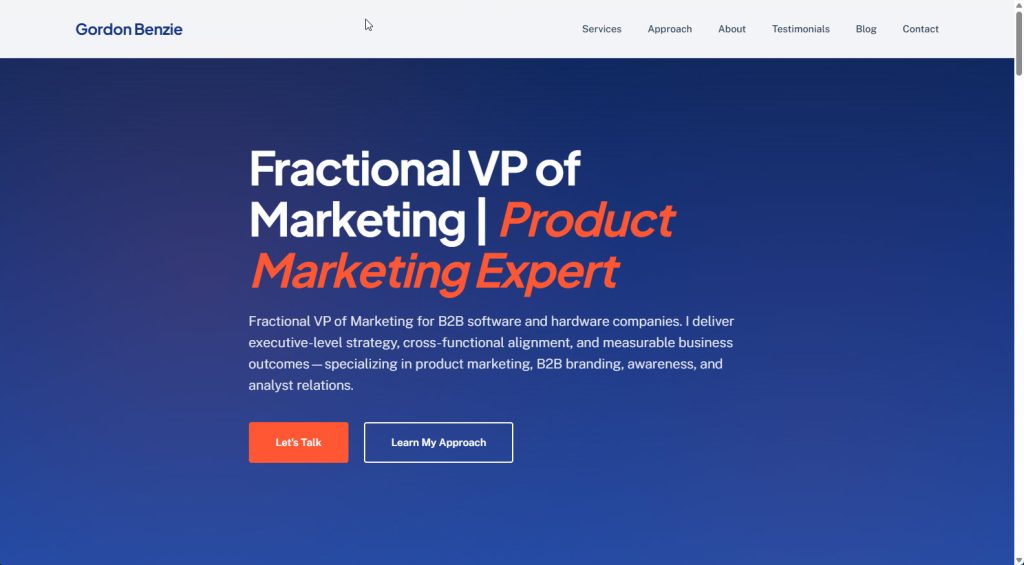
Last week, I chose to explore generative AI through Claude by Anthropic. My focus was to explore its coding capability, specifically on how well it could build a website. And, how well it could help with preparing the written content as part of website creation. Rather than testing small samples, I committed to a full rebuild of my personal website. The goal was to understand both the speed and quality of output that modern AI could deliver.
The result was impressive. I rebuilt an entirely new website in half a day. Historically, that process would have taken weeks. Note that this process included at least 10 iterations as I discovered new items I wanted to update or improve. I am continuously improving my site, which is quite valuable. No longer do technology or systems impede progress!
This experience highlighted a key aspect of marketing disruption. AI does not just accelerate launches. It changes behavior. Iteration becomes easier, which encourages ongoing optimization rather than one-time execution.
What Marketing Disruption Reveals About Strategy
Working closely with generative AI has reinforced an important lesson. Marketing disruption does not eliminate the need for strategy. It increases it. AI reflects the quality of inputs it receives. Clear thinking produces strong output. Vague direction produces noise.
In practice, AI acts as a diagnostic tool. Weak positioning becomes obvious. Inconsistent messaging surfaces quickly. This makes marketing disruption uncomfortable for some teams, but invaluable for those willing to improve.
Marketing has always relied on systems. AI simply accelerates them. Well-designed workflows scale rapidly. Poorly designed ones fail just as fast. The super marketer focuses on building repeatable processes that improve over time. This perspective only comes with experience. Those new to the field get caught up in the “wow” factors, but typically don’t have the right perspective to see how best to effectively proceed forward.
Fundamentals still matter deeply. Audience insight, value propositions, and brand voice remain critical. Marketing disruption removes the ability to hide behind activity. At scale, quality becomes impossible to fake.
The Next Phase of Marketing Disruption: Agentic AI
The next major wave of marketing disruption will come from agentic AI systems. These tools go beyond responding to prompts. They plan tasks, execute actions, monitor performance, and adjust based on feedback.
For marketers, this represents a significant productivity shift. Research, content drafting, testing, and reporting can operate semi-autonomously. The marketer provides direction and oversight, while the system handles execution.
My next focus will be on exploring how agentic AI processes can improve productivity and performance in new practical ways. The goal is not full automation. It is intelligent automation that enhances quality while preserving human control.
Used carefully, agentic AI can transform marketing into a living system. One that learns, adapts, and improves continuously. This is marketing disruption at the operational level, not just the tactical one. Note that this concept applies to other fields outside of marketing, too, but that is a story for another article.
AI Marketing Tools Shaping the Disruption Ahead
Several categories of AI tools will continue shaping marketing disruption throughout the year. AI-powered customer data platforms are advancing rapidly, unifying behavioral data and surfacing insights that would be difficult to uncover manually.
Predictive analytics tools are also gaining traction. These systems forecast campaign performance before launch, helping marketers allocate resources more effectively and reduce wasted spend.
Creative testing platforms now use AI to generate and evaluate variations of headlines, visuals, and calls to action. Optimization becomes continuous rather than episodic. AI-driven SEO tools are shifting focus toward search intent and content quality, aligning more closely with modern algorithms.
Conversational AI continues to mature as well. Chat-based experiences are becoming more contextual, blending customer service and marketing into a single interaction. Workflow orchestration tools tie these capabilities together, preventing fragmentation as AI adoption grows.
Adapting to Ongoing Marketing Disruption
Marketing disruption driven by AI is not a passing phase. It is a structural shift in how marketing work gets done. Fewer people will accomplish more, with greater speed and precision. Skills, judgment, and adaptability will matter more than ever.
Those who experiment and learn through real projects will move ahead quickly. Those who wait for certainty will struggle to keep pace. AI is not slowing down, and neither is the competitive landscape.
The path forward is clear. Embrace marketing disruption. Learn by doing. Build systems that improve daily and focus on tools that deliver measurable results.
The AI-enabled super marketer is already here. The only question is who is willing to adapt and become one.
